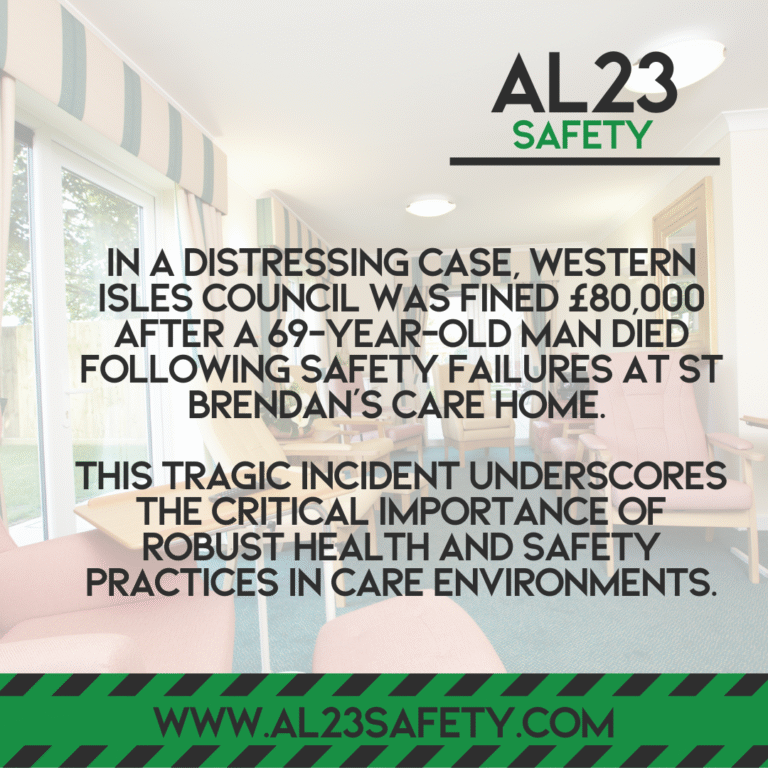
Care home safety compliance is the bedrock of protecting vulnerable residents, yet its neglect can unleash unimaginable tragedy. The heartbreaking death of 69-year-old Allan MacLeod at St Brendan’s Care Home in Castlebay, Isle of Barra, exemplifies this peril. On 9 March 2024, Mr MacLeod, who had dementia, slipped out undetected through an unalarmed door, wandered for four hours, and was found with fatal facial injuries from a fall. Western Isles Council, the operator, was fined £80,000 at Lochmaddy Sheriff Court on 6 August 2025 for breaching Sections 3(1) and 33(1)(a) of the Health and Safety at Work etc. Act 1974, following a Health and Safety Executive (HSE) probe. This preventable loss amid prior escape attempts and ineffective safeguards highlights systemic failures in care home risk assessment and monitoring. At AL23 Safety, we champion rigorous health and safety care homes protocols to avert such horrors. In this post, we unpack the St Brendan’s case, UK regulations, and five devastating lessons to fortify your care home safety compliance and honour residents’ dignity.
The St Brendan’s Tragedy: A Timeline of Lapses in Care Home Safety Compliance
Allan MacLeod entered St Brendan’s in October 2023 to stay closer to family on Barra, enjoying initial road trips that showcased his spirit despite dementia. Staff noted his wandering tendencies early, conducting a December 2023 risk assessment that flagged tag removal risks, yet vigilance waned. Electronic tags were fitted but routinely discarded by Mr MacLeod, with no robust follow-up. On that fateful March morning, he exited via the sole unalarmed door, despite plans for keypad systems eluding detection until dawn. Resuscitation failed; he passed in hospital an hour later.
The HSE investigation revealed multiple red flags: prior escape bids ignored, delayed upgrades, and absent half-hourly checks. Post-tragedy, the home implemented hourly rounds and completed door keypads, but as HSE inspector Ashley Fallis stated, “This was a tragic and preventable death. The council should have made sure the home had stronger measures in place with Mr MacLeod’s risks already known and assessed.” The £80,000 penalty, plus costs, pales against the human toll, eroding trust in a sector serving 500,000+ UK residents amid rising dementia cases (projected 1 million by 2025 per Alzheimer’s Society). This incident spotlights how care home safety compliance gaps beyond finances jeopardise lives, reputations, and community faith.
UK Legal Framework: Enforcing Care Home Safety Compliance
Care home safety compliance stems from the Health and Safety at Work etc. Act 1974, mandating employers to ensure, so far as reasonably practicable, non-employees’ safety (Section 3(1)). The Regulatory Reform (Fire Safety) Order 2005 and Care Quality Commission (CQC) standards amplify this for residential settings, requiring dynamic risk assessments under the Management of Health and Safety at Work Regulations 1999.
For dementia patients, HSE guidance stresses tailored interventions: person-centred plans addressing elopement via alarms, GPS, or environmental controls. The Health and Social Care Act 2008 (Regulated Activities) Regulations 2014 demands safe staffing and monitoring, with CQC inspections flagging non-compliance. Breaches invite unlimited fines, enforcement notices, or closure, Western Isles’ case drew swift prosecution, underscoring timely action’s imperative. Integrating these with Mental Capacity Act 2005 ensures ethical, proportionate safeguards, balancing autonomy and protection in health and safety care homes.
5 Devastating Lessons from St Brendan’s on Care Home Safety Compliance
The MacLeod tragedy yields profound, actionable insights. Here are five lessons to elevate your care home risk assessment and dementia patient safety:
1. Embed Dynamic, Person-Centred Risk Assessments in Daily Operations
A static December assessment failed to adapt to Mr MacLeod’s tag-removal pattern. Lesson: Update assessments monthly for high-risk residents, using tools like the HSE’s dementia risk matrix. Involve multidisciplinary teams nurses, psychologists, families to map behaviours, trialling layered defences (e.g., wander guards plus visual cues). This proactive care home safety compliance prevents escalation from known vulnerabilities.
2. Implement Robust Technological and Environmental Safeguards Without Delay
Planned keypads languished, leaving the exit vulnerable. Lesson: Prioritise installations within 30 days of assessment flags, opting for integrated systems like door alarms, bed sensors, and non-removable GPS. Conduct bi-annual audits to verify functionality, aligning with CQC’s safe environment key lines. Swift execution transforms reactive fixes into impenetrable barriers for dementia patient safety.
3. Enforce Rigorous Monitoring Protocols with Scheduled Checks
Four hours elapsed before discovery, sans routine rounds. Lesson: Adopt half-hourly checks for wander-prone individuals, logged digitally for traceability. Use apps like CareDocs for real-time alerts, ensuring coverage during night shifts. This vigilance now standard at St Brendan’s, embeds health and safety care homes as a non-negotiable rhythm, slashing undetected absences.
4. Deliver Continuous, Specialised Staff Training on Vigilance and Empathy
Tag defeats went unchecked due to training shortfalls. Lesson: Mandate annual HSE-aligned sessions on dementia behaviours, de-escalation, and protocol adherence, plus quarterly refreshers. Certifications from the National Care Association build competence, fostering a “see something, act immediately” ethos. Invested teams not only comply but anticipate, elevating care home staff training to life-preserving proficiency.
5. Cultivate a Transparent Culture of Accountability and Continuous Improvement
Post-incident changes were laudable but tardy. Lesson: Establish safety committees for quarterly reviews, incorporating incident learnings and resident feedback. Benchmark against CQC reports, rewarding proactive reports via incentives. This holistic approach ensures care home safety compliance evolves, turning tragedies into sector-wide safeguards.
Broader Ramifications: The Human and Systemic Cost of Lapses
Beyond St Brendan’s, neglected care home safety compliance burdens the NHS with £6 billion annual dementia costs, per King’s Fund estimates, while eroding provider viability fines and closures hit SMEs hardest. Families suffer profound grief, as Mr MacLeod’s relatives endured, amplifying calls for mandatory elopement tech under proposed Care Act reforms. Positively, compliant homes boast 20% fewer incidents (HSE data), lower premiums, and higher CQC ratings, attracting quality staff in a 152,000-vacancy market.
SMEs can leverage free HSE e-learning; larger chains benefit from AI monitoring pilots. Ultimately, compliance isn’t bureaucratic, it’s compassionate stewardship.
Partner with AL23 Safety for Unrivalled Care Home Safety Compliance
The St Brendan’s shadow lingers, but its lessons illuminate a safer path. At AL23 Safety, we craft bespoke care home risk assessment plans, staff training, and audits to meet UK standards seamlessly. Our consultants navigate CQC inspections, dementia-specific strategies, and crisis simulations, easing pressures while amplifying outcomes.
Don’t let oversight claim another life. Contact AL23 Safety for a complimentary compliance review today. Visit our services page to fortify your facility, protect your residents, and embody true care. Together, we honour Allan MacLeod by making prevention the promise.
![Creating a Safer Workplace: The Importance of Health and Fire Safety Services In today's business environment, prioritising health and fire safety is not just a regulatory obligation but a moral imperative. With the constant evolution of legislation and safety standards, businesses must stay informed and compliant to protect their employees and assets. At AL23 Safety, our comprehensive range of services supports you in developing a safer, more compliant, and productive workplace. Understanding the Legislative Landscape To create a robust health and safety culture, businesses must understand the intricate web of UK regulations that govern workplace safety. The Health and Safety at Work Act 1974, the Regulatory Reform (Fire Safety) Order 2005, and the Management of Health and Safety at Work Regulations 1999, among others, set the foundation for compliance. Our consultants at AL23 Safety leverage extensive knowledge of these laws to provide tailored strategies, ensuring you meet and exceed compliance expectations. Tailored Fire Risk Assessments One of our core offerings is detailed fire risk assessments. The Regulatory Reform (Fire Safety) Order mandates that businesses conduct thorough assessments to identify fire hazards, evaluate risks, and implement control measures. We employ a meticulous approach by analysing the specific needs of your establishment, ensuring that every potential risk is addressed effectively. Fire Strategy Development In conjunction with risk assessments, we develop bespoke fire strategies that align with your unique operational needs. This proactive planning not only helps in compliance but significantly reduces the likelihood of incidents, creating a safer environment for everyone. Our approach is data-driven, allowing us to implement strategies supported by best practice guidelines and industry standards. Ongoing Support and Training Safety doesn’t stop at implementation. AL23 Safety offers ongoing support and training to ensure your team is equipped to handle emergencies. Our training sessions cover essential areas, including fire safety protocols, evacuation procedures, and equipment handling. With 24/7 access to our consultancy services, you can navigate challenges with confidence, knowing that expert advice is just a call away. Empowering Your Business Through Safety At AL23 Safety, we are dedicated to empowering businesses by cultivating an environment of safety that nurtures productivity and innovation. Our hands-on consultants are not just experts; they are your partners in achieving a culture of excellence in health and safety. Partnering with us means choosing a future where safety is ingrained in every aspect of your operations. Let us help you navigate the complexities of health and fire safety. Discover our tailored services that can transform your workplace into a model of compliance and safety excellence. [Visit our services] for more information.](https://al23safety.com/wp-content/uploads/2026/04/CreatingaSaferWorkplaceTheEssentialRoleofHealthandFireSafetyServices.png)