5 Powerful Reasons to Choose AL23 Safety for Ultimate Health and Fire Safety Excellence
Achieving Excellence in Health and Fire Safety Management: The Comprehensive Approach of AL23 Safety In today’s intricate business landscape, ensuring the safety and well-being of your employees is more critical than ever. Not only is it a legal duty, but fostering a safe work environment can also lead to increased productivity and employee satisfaction. At AL23 Safety, we pride ourselves on being at the forefront of health and fire safety consultancy in the UK. Our full range of services is designed to support businesses in creating safer, compliant, and more productive environments. Understanding UK legislation on health and fire safety is essential for every business. Compliance is not merely a box-ticking exercise; it is a fundamental aspect of operational integrity. With extensive knowledge of current regulations, we help businesses navigate the complexities of safety management, ensuring adherence while optimising performance. Our fire safety services are comprehensive and tailored to meet the unique needs of each business sector. From detailed fire risk assessments to the development of robust fire strategies, we equip your organisation with the tools to effectively manage fire risks and protect both lives and assets. Our expert consultants, with hands-on experience, take the time to understand your specific requirements, enabling us to deliver bespoke solutions that address your distinct challenges. Moreover, we recognise that ongoing support is crucial. That’s why we offer 24/7 access to our consultancy team. This commitment to being there for you, regardless of the time or situation, underscores our dedication to your safety. Whether you require immediate advice following an incident or long-term safety management strategies, we are just a call away. Training is another vital component of our approach. Ensuring that employees are well-informed about safety protocols not only cultivates a culture of safety but also significantly reduces risks. AL23 Safety provides tailored training sessions aimed at empowering your workforce with the necessary knowledge and skills. By fostering a proactive safety culture, we believe businesses can significantly enhance their performance, reduce accidents and liability, and ultimately thrive. With AL23 Safety as your partner, you are not just ensuring compliance; you are investing in a safer future for your organisation. Visit our services today and take the first step toward achieving the highest standards in health and fire safety management.

Health and fire safety is a top priority for every responsible UK business in today’s demanding environment. At AL23 Safety, we deliver expert, tailored solutions that go beyond basic compliance to create genuinely secure workplaces. Our comprehensive approach combines deep regulatory knowledge with practical, hands-on support, helping organisations across sectors reduce risks, boost productivity and […]

7 Powerful Reasons Why DSEAR Risk Assessments Transform Workplace Safety
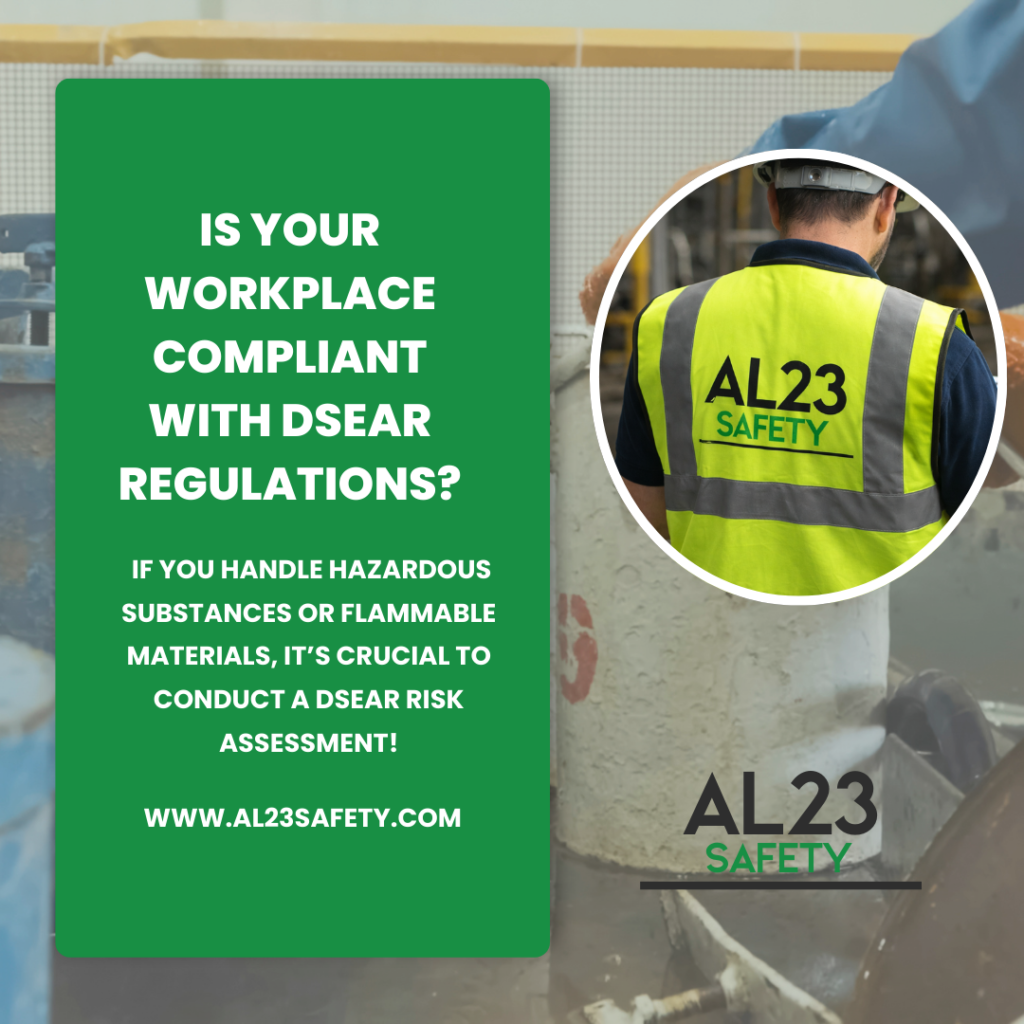
In today's rapidly evolving business landscape, ensuring workplace safety is not just a regulatory requirement but a critical aspect of operations, especially for companies dealing with hazardous substances. One of the key regulations to be aware of is the Dangerous Substances and Explosive Atmospheres Regulations (DSEAR), which mandates that employers assess and manage risks associated with dangerous substances. This article aims to delve into the importance of conducting a thorough DSEAR Risk Assessment, outlining how it can help protect your employees, enhance compliance, and improve operational efficiency. At AL23 Safety, we understand that every business is unique, with distinct needs and risks. Therefore, our approach to DSEAR Risk Assessments is tailored specifically to each client. Our expert consultants bring a wealth of knowledge in identifying potential dangers, evaluating the risks, and implementing effective control measures. Why is a DSEAR Risk Assessment Necessary? Regulations under DSEAR require employers to assess the risks of fire and explosion from dangerous substances present in the workplace. These assessments are essential for several reasons: 1. Legal Compliance - Failing to comply can lead to legal actions, fines, and damage to your brand's reputation. 2. Employee Safety - Protecting your employees is the foremost reason for any workplace safety initiative. 3. Operational Efficiency - By proactively managing hazards, you can avoid potential disruptions and ensure smoother operations. The Process of Conducting a DSEAR Risk Assessment To effectively conduct a DSEAR Risk Assessment, businesses should engage in a systematic process: 1. Identify Dangerous Substances: Determine which materials in your workplace are classified as dangerous under the regulations. This could include anything from industrial solvents to gases. 2. Assess the Risks: For each identified substance, evaluate the risk of fire or explosion and consider factors such as the quantity of the substance present and the potential ignition sources. 3. Implement Control Measures: After identifying risks, it’s essential to put in place control measures that may include engineering controls, personal protective equipment (PPE), or administrative changes. 4. Document Findings: It is critical to document the process thoroughly, noting all findings and measures taken, so that you can demonstrate compliance. 5. Review and Update: DSEAR Risk Assessments are not a one-time requirement. Regular reviews and updates are necessary, especially when changes occur in processes, equipment, or workplace layout. Real-World Impact of DSEAR Assessments At AL23 Safety, we have witnessed how effective DSEAR Risk Assessments have transformed businesses. One recent client in the manufacturing sector faced challenges with compliance due to the flammable substances they used in production. After conducting a comprehensive DSEAR assessment, we identified several potential ignition sources and provided actionable recommendations that led to significant improvements in their safety protocols. The result was not only compliance but also enhanced employee confidence and safety culture within the workplace. Conclusion In conclusion, a DSEAR Risk Assessment is an essential component of workplace health and safety for any business dealing with hazardous substances. AL23 Safety stands ready to support organisations in this critical area – ensuring your business remains compliant, your employees are safe, and your operations are efficient. For a tailored solution and expert guidance on DSEAR Risk Assessments, visit our services.

DSEAR Risk Assessments are a cornerstone of workplace safety for any UK business that handles or stores dangerous substances. These specialised evaluations help identify and control the risks of fire, explosion and corrosion from hazardous materials, ensuring full compliance with the Dangerous Substances and Explosive Atmospheres Regulations 2002 (DSEAR). At AL23 Safety, we specialise in […]

5 Shocking Lessons from Isoma’s £16,000 Fine That Could Devastate Your Business
The recent case of Isoma Limited, wherein an 18-year-old employee suffered a broken arm due to inadequate safety measures while using a manual lathe, underscores the critical importance of workplace safety. Despite clear guidelines surrounding risk assessments for equipment like lathes, Isoma Ltd's neglect led to a significant fine of £16,000. When operating machinery, particularly in manufacturing, it’s imperative that companies establish a safe system of work and execute suitable assessments of usage risks. The Health and Safety Executive (HSE) states that every business should have robust measures in place to mitigate risks, especially for tasks as hazardous as deburring on a rotating lathe. According to HSE guidelines, businesses must evaluate whether certain risks, such as using emery cloth on tools, can be entirely eliminated. If complete elimination isn't feasible, companies must outline safe working procedures that ensure employees operate machinery without undue risk of injury. Engaging in a proactive approach towards health and safety has far-reaching benefits—not only does it fulfil legal obligations, but it also cultivates a culture of safety within the organization. Companies like AL23 Safety offer vital support in navigating complex safety requirements, ensuring that all employees, particularly younger and less experienced workers, benefit from a safer work environment. The primary takeaway is that workplace safety isn't just an option—it's a necessity. Employers must take responsibility for conducting comprehensive risk assessments and creating a safe working atmosphere. If you want to learn more about how your business can follow the best practices in health and safety compliance, visit our services to explore tailored solutions that fit your needs.

Workplace safety remains a non-negotiable priority for every UK business, especially in manufacturing environments where machinery poses significant risks. The recent case of Isoma Limited, fined £16,000 by the Health and Safety Executive (HSE), serves as a stark reminder of what happens when companies fail to implement proper safeguards. An 18-year-old employee suffered a broken […]

7 Powerful Strategies to Dramatically Reduce Hot Work Fire Risks in Your Workplace
In recent years, the risks associated with ‘hot work’ activities have come under intense scrutiny. Recent analyses of fire incidents highlight the notable dangers these activities pose, especially with welding and cutting being implicated in a substantial majority of fire incidents. This blog post will dive deep into the trends observed in fire safety, focusing on the implications for businesses using hot work as part of their operations. Understanding the risks associated with hot work is essential for any business. Hot work refers to any work that generates sparks, flame, or heat, which can easily ignite combustible materials nearby. Common forms of hot work include welding, cutting, grinding, and the use of blow torches. According to recent data from the Office for National Statistics, the 2023-2024 financial year recorded 199 hot work-related fires in England, a number that illustrates the pressing necessity for businesses to adopt comprehensive fire safety practices. With 85% of such incidents attributed to welding and cutting, businesses should take this information seriously, ensuring they have suitable risk assessments and control measures in place. A robust fire risk assessment is foundational, identifying potential hazards, evaluating risks, and implementing strategies to mitigate those risks. The significant drop in total hot work fires from 2023 to 2025 highlights the effectiveness of training and awareness campaigns. However, despite this improvement, businesses cannot afford to be complacent. Every workplace engaged in hot work must rigorously enforce hot work permits, which require systematic checks and balances to ensure safety compliance. Training is another vital area that businesses should focus on. Staff should not only receive instructions on operating machinery safely but also on the specific dangers associated with hot work. This includes understanding the importance of monitoring conditions before, during, and after hot work operations. Regional variations in the data also reveal alarming trends, with some areas demonstrating a higher prevalence of hot work-related incidents. Independently of the statistics, it’s essential that both management and employees engage in a collective responsibility towards workplace safety. Establishing a culture of safety can lead to better compliance with safety protocols and thus safer workplaces. Ultimately, the data underscores the importance of meticulous management of hot work activities. Businesses can take proactive measures to protect themselves, but they must approach hot work with the seriousness it deserves. By embracing vigilant practices and staying informed about the legal responsibilities related to fire safety, we can significantly reduce risks, protect lives, and safeguard property. For comprehensive support in navigating fire risks, tailored safety solutions, and effective training, reach out to your fire safety consultants at AL23 Safety. We aim to help businesses create safer environments that meet compliance requirements—because when it comes to fire safety, every detail matters.

Hot work fire risks continue to pose a serious threat to workplaces across the UK, particularly in industries involving welding, cutting, grinding and other spark-generating tasks. Recent data highlights the ongoing challenges, with 381 hot work-related fires recorded in England between 2023 and 2025, the majority sparked by welding or cutting activities. Despite a 9% […]

Construction Client Duties: A Vital Wake-Up Call for the UK Industry

In a significant and sobering case for the construction industry, Moses Meisels received a 12-week suspended prison sentence after serious health and safety failures led to the discovery of a man’s body at a construction site in Hackney, London. This incident highlights the paramount importance of fulfilling legal responsibilities as a construction client, as set out in the Construction (Design and Management) Regulations 2015. In December 2018, the Metropolitan Police found the body of a man at the site of a synagogue development, although the cause of death was determined to be natural. Following the discovery, inspections by the Health and Safety Executive (HSE) revealed alarming safety violations, predominantly concerning measures to prevent falls from height, along with various breaches of good order and safe access. Inspector David King led the investigation and explained that despite multiple warnings regarding safety practices, Meisels continued to disregard essential health and safety standards. His role as a client meant he bore significant responsibility for ensuring that the construction project adhered to legal expectations concerning risk management. During the investigation, numerous hazardous conditions were identified. For instance, inadequate edge protection was evident, which could have resulted in serious injuries from falls. Additionally, there were failures in appointing a principal contractor, documenting construction phase plans, and implementing adequate health and safety practices throughout the project lifecycle. At court, Meisels pleaded guilty to breaching the Construction (Design and Management) Regulations 2015, which unequivocally state the responsibilities of clients in relation to health and safety management. The court acknowledged the high level of culpability in his actions, noting that ignoring employee concerns and allowing safety breaches to persist significantly contributed to the seriousness of the offence. This case serves not only as a compelling reminder of the consequences of failing to comply with health and safety regulations, but also as a call to action for other clients within the construction industry. A client’s influence over a project can determine its safety; it is vital to make suitable arrangements for managing health and safety effectively. Clients should ensure that they appoint competent individuals, maintain necessary documentation, and actively monitor safety practices throughout the project's duration. Moreover, they must cultivate a safety culture that encourages reporting and swift remedial action in response to concerns or breaches. Learning from this case can help mitigate risks and build a safer construction environment. As highlighted by HSE guidance, clients must not only be aware of their duties but also take responsibility for fulfilling them to prevent tragic incidents in the future. For businesses aiming to enhance their safety protocols, it is essential to explore comprehensive health and safety management solutions tailored specifically for construction environments. For the highest standards of compliance and to safeguard your workers, effective planning, resource allocation, and proactive management are paramount. Consider implementing regular training sessions, risk assessments, and empowerment strategies that involve all site personnel in maintaining health and safety expectations. By taking these steps, you contribute to a firm foundation for safe operations and compliance in the ever-demanding construction industry landscape.

Construction client duties under the Construction (Design and Management) Regulations 2015 (CDM 2015) are not optional, they are legal obligations that can carry severe consequences when ignored. A recent case in Hackney, London, powerfully illustrates the risks of failing to meet these construction client duties and serves as a stark reminder for every client overseeing […]

7 Critical Fire Safety Compliance Lessons from Warrington Prosecution Nightmare
The Importance of Fire Safety Compliance: Lessons from a Warrington Case The recent prosecution of Warrington business owner Muhammad Wasim offers vital lessons about the importance of fire safety compliance for all business owners. Facing a fine of £4,420 after breaching fire safety regulations, Wasim disregarded a Prohibition Notice issued by Cheshire Fire and Rescue Service, allowing the continued use of a commercial premises for residential purposes. This case illustrates the severe consequences of ignoring fire safety measures and highlights the key areas that need attention and compliance in every business environment. The Regulatory Reform (Fire Safety) Order 2005 mandates that business owners fulfil their fire safety responsibilities, ensuring the safety of employees and tenants. During a thorough inspection, emergency services uncovered critical deficiencies: - Inadequate separation between commercial and residential areas puts lives at risk. - Insufficient fire detection systems hinder prompt responses during emergencies. - Compromised escape routes create potential hazards, especially during a fire. - Absence of emergency lighting further endangers the tenants' safety in the event of an emergency. The Prohibition Notice aimed to mitigate risks by prohibiting the use of certain areas for residential purposes; ignoring such legal notices can lead to serious legal repercussions, as seen in Wasim's case. Fire safety compliance is not just a legal obligation but a moral one; it safeguards lives and protects property. The take-away? Conduct regular fire risk assessments and maintain ongoing training for all employees about fire exits, alarms, and safe behaviour. Work with experts like AL23 Safety to develop and implement robust fire strategies tailored to your specific needs. Remember, fire safety compliance isn't optional! It’s vital for protecting your business and its occupants. For expert advice and tailored fire safety solutions, visit our services today.

Fire safety compliance is non-negotiable for any business owner in the UK, and a recent prosecution in Warrington serves as a stark reminder of the devastating consequences of neglecting it. In late 2025, Warrington business owner Muhammad Wasim was fined £4,420 after pleading guilty to breaching vital fire safety regulations. Despite receiving a Prohibition Notice […]

Avoid £500,000 Fines: Essential Vibration Risk Management in 2026
**Understanding the Dangers of Vibration Exposure in the Workplace** The recent fine of Nottingham City Homes Limited for failing to protect employees from Hand-Arm Vibration Syndrome (HAVS) is a significant reminder of the importance of workplace safety. With numerous reports of vibration-related illnesses, this case illustrates the dire consequences of neglecting health and safety regulations. As a business, understanding the risks associated with vibration exposure from tools and machinery is crucial. This blog will delve into the legal obligations surrounding vibration management, the impact of vibration on employee health, and how AL23 Safety can assist in creating a compliant safety management system. ## What is Hand-Arm Vibration Syndrome (HAVS)? HAVS is a condition that results from frequent and regular exposure to hand-arm vibration. Symptoms include tingling, numbness, and loss of strength, which can render daily tasks, such as writing or holding utensils, impossible. Employers have a legal responsibility to protect employees from this harmful exposure, especially those using hand-held power tools and machinery in their roles. ## The Legal Framework The Health and Safety at Work Act 1974 places a clear responsibility on employers to ensure the safety and health of their workforce. Specifically, the Control of Vibration at Work Regulations 2005 outlines requirements for managing vibration risks. These regulations mandate that employers conduct suitable and sufficient risk assessments, implement control measures, and ensure that employees receive adequate health surveillance. By failing to implement these measures, as highlighted in the Nottingham City Homes Limited case, employers expose their organisations to significant legal and financial repercussions. ## Implementing Vibration Risk Control Measures Effective risk management involves: 1. **Risk Assessment**: Identifying which tasks involve vibration exposure and assessing the risk level. 2. **Control Measures**: Implementing strategies to reduce exposure, including using lower vibration tools, maintaining equipment, and limiting the time employees spend on tasks with vibration exposure. 3. **Training**: Providing employees with information about the risks associated with vibration and training on how to use tools safely. ## Tailored Solutions with AL23 Safety At AL23 Safety, our expert consultants are equipped to help your business navigate the complexities of health and safety regulations. We offer comprehensive risk assessments, bespoke safety strategies, and ongoing support to ensure that your organisation is always compliant. Don't wait for an incident to occur. Prioritise the health and safety of your workforce today by reaching out to us for tailored safety solutions. Let’s work together to create a safer workplace that meets the highest standards of compliance. Visit our services to learn more about how we can support you in achieving this goal.

Vibration risk management is no longer optional in today’s workplaces. The recent prosecution and substantial fine imposed on Nottingham City Homes Limited serves as a stark warning to all UK employers: failing to address vibration risks can lead to severe financial penalties, legal consequences, and irreversible harm to employees. In this post, we explore the […]