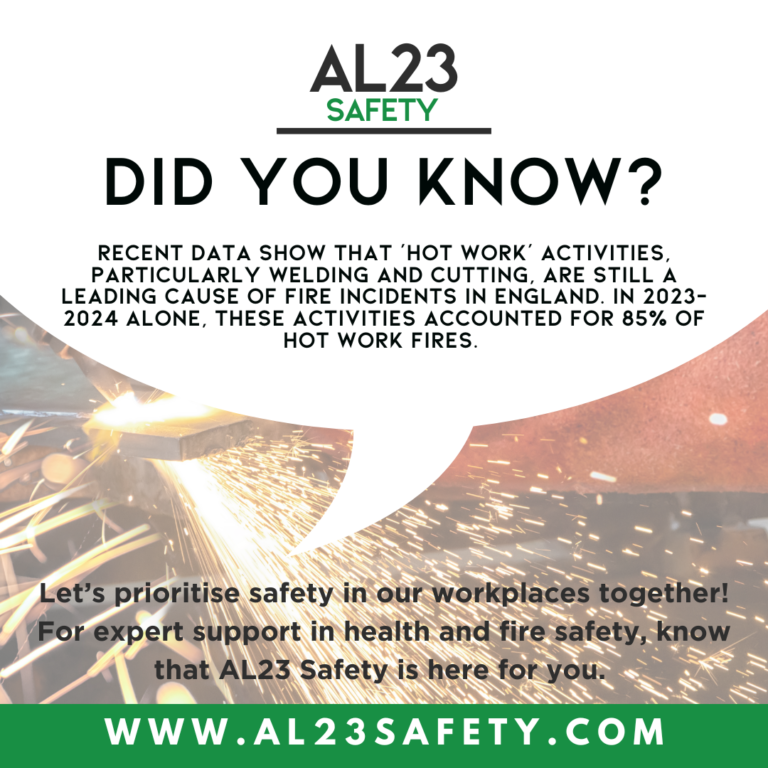
Hot work fire risks continue to pose a serious threat to workplaces across the UK, particularly in industries involving welding, cutting, grinding and other spark-generating tasks. Recent data highlights the ongoing challenges, with 381 hot work-related fires recorded in England between 2023 and 2025, the majority sparked by welding or cutting activities. Despite a 9% drop from 199 incidents in 2023-2024 to 182 in 2024-2025, these figures underscore the need for vigilant hot work fire safety measures to protect lives, property and businesses.
Hot work refers to any task that produces flames, sparks or intense heat capable of igniting nearby combustible materials. Common examples include arc welding, oxy-fuel cutting, grinding and the use of blowtorches. Such activities are essential in construction, manufacturing, maintenance and shipbuilding, yet they carry inherent dangers if not properly controlled.
The Current Landscape of Hot Work Fire Risks in the UK
Recent analyses of Office for National Statistics (ONS) data reveal persistent patterns in hot work fire risks. In the 2023-2024 financial year, 199 fires were linked to hot work, with 85% attributed to welding and cutting. The following year saw a slight improvement, with 182 incidents (still 85% from welding/cutting), representing about 1.3% of all non-dwelling fires. Over the two years, these fires resulted in 32 incidents involving casualties or fatalities.
Regional differences add another layer of concern. Areas like Cumbria showed the highest proportion of hot work fire risks relative to non-dwelling fires in 2024-2025 (4.55%), followed by Derbyshire and Cornwall. These variations highlight how local industries and practices influence incident rates, emphasising the importance of tailored approaches to reducing hot work fires.
The good news is that overall trends show progress, likely due to increased awareness, better training and stricter enforcement of safety protocols. However, complacency is not an option; every incident is preventable with the right controls.
Essential Strategies for Reducing Hot Work Fire Risks
To effectively manage hot work fire risks, businesses must adopt a multi-layered approach. Here are key strategies proven to enhance hot work fire safety:
1. Conduct Thorough Fire Risk Assessments
A comprehensive fire risk assessment forms the foundation of any safety programme. Identify potential ignition sources, combustible materials and vulnerable areas before starting hot work. Evaluate risks specific to the site, considering factors like ventilation, proximity to flammable substances and emergency access. Regularly review and update assessments to reflect changes in operations or environment.
2. Implement Strict Hot Work Permit Systems
Hot work permits are one of the most effective tools for reducing hot work fires. These permits require pre-work checks, including inspection of the work area, removal or shielding of combustibles, provision of fire extinguishers and designation of a fire watcher. Permits should outline conditions for safe execution, duration and post-work monitoring (often for at least 30-60 minutes after completion to detect smouldering). Enforce permit-to-work rigorously, no exceptions.
3. Prioritise Comprehensive Training and Competency
Staff involved in hot work must receive specialised training beyond general machinery operation. Cover the specific hazards of sparks, heat transfer and hidden fire risks (e.g., sparks travelling through ducts). Train workers on permit procedures, emergency responses and the importance of continuous monitoring. Refresher courses and competency assessments ensure knowledge remains current, significantly contributing to welding fire prevention and overall safety.
4. Use Engineering Controls and Safe Work Practices
Isolate hot work areas with fire-resistant screens or blankets. Ensure adequate ventilation to disperse fumes and reduce oxygen levels near potential ignition points. Keep appropriate fire-fighting equipment (extinguishers, fire watches, hose reels) immediately available. Schedule hot work during low-risk periods when fewer combustibles are present and avoid conducting it in high-hazard zones without extra precautions.
5. Establish a Strong Safety Culture
Foster collective responsibility through leadership commitment and employee involvement. Encourage reporting of near-misses, regular safety briefings and audits of hot work activities. When everyone understands the consequences of hot work fire risks and feels empowered to intervene, compliance improves dramatically.
6. Monitor and Learn from Data and Incidents
Track internal hot work activities and near-misses. Analyse any incidents to identify root causes and implement corrective actions. Stay informed about national trends, such as the persistent 85% link to welding/cutting to prioritise high-impact controls.
7. Ensure Legal Compliance and Professional Support
UK regulations, including the Regulatory Reform (Fire Safety) Order 2005, require duty holders to manage fire risks effectively. Non-compliance can lead to severe penalties. Partnering with experienced consultants ensures your measures meet standards and best practices.
By implementing these strategies, businesses can achieve substantial reductions in hot work fire risks, creating safer environments for all.
In conclusion, while progress has been made in reducing hot work fires, the data clearly shows that welding and cutting remain primary culprits. Proactive management through risk assessments, permits, training and a robust safety culture is essential. Don’t leave safety to chance, take decisive action today.
For expert guidance on managing hot work fire risks, tailored training programmes and compliance support, contact the team at AL23 Safety. We’re dedicated to helping UK businesses build safer workplaces where every precaution counts. Reach out now to discuss how we can support your operations.