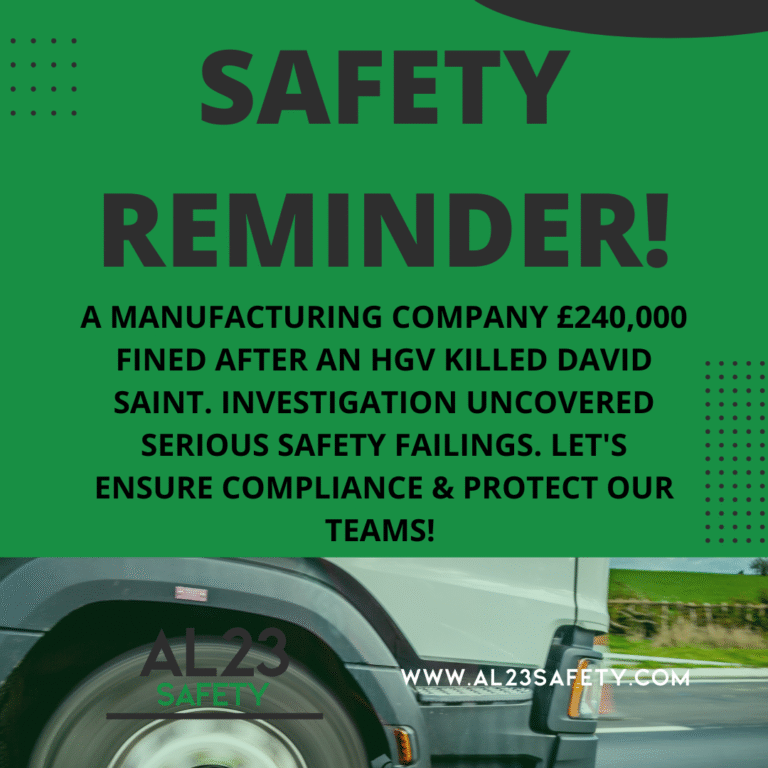
Workplace transport safety remains one of the most pressing concerns for UK businesses, particularly when vehicles and pedestrians share the same space. The heartbreaking death of David Saint, a much-loved grandfather, killed by a reversing heavy goods vehicle (HGV) at Northwood Consumer Limited, serves as a stark reminder that preventable incidents can have devastating consequences. The company’s subsequent substantial fine highlights the serious legal and financial repercussions of failing to manage these risks effectively.
Every year, incidents involving moving vehicles account for a significant proportion of workplace fatalities in the UK. According to Health and Safety Executive (HSE) statistics, pedestrian-worker collisions with forklifts, HGVs, and other site vehicles consistently rank among the top causes of fatal accidents. This sobering reality reinforces why robust workplace transport safety measures must be at the heart of every organisation’s health and safety strategy.
Why Workplace Transport Safety Demands Urgent Attention
The Health and Safety at Work etc. Act 1974 places a clear duty on employers to ensure, so far as is reasonably practicable, the health, safety, and welfare of all employees and others affected by their operations. When it comes to vehicle movements on site, this means conducting suitable and sufficient workplace transport risk assessment activity. Too often, risks associated with reversing manoeuvres are underestimated, yet these movements are disproportionately involved in serious incidents.
Effective workplace transport safety starts with eliminating or reducing vehicle-pedestrian interaction wherever possible. Practical steps include:
- Segregating pedestrian and vehicle routes using barriers, markings, and designated walkways
- Installing clear signage and mirrors at blind spots
- Fitting vehicles with audible and visual reversing alarms, proximity sensors, and cameras
- Implementing one-way systems to minimise the need for reversing
- Providing high-visibility clothing and enforcing its use
Key Lessons from the Tragic David Saint Incident
The case at Northwood Consumer Limited offers seven critical lessons that every business should apply immediately:
- Never assume drivers can see everything – Blind spots on HGVs are extensive; technology and physical controls must compensate.
- Risk assessments must be site-specific – Generic templates are insufficient for genuine workplace transport safety.
- Reversing should be avoided wherever practicable – If reversing is unavoidable, banksmen or advanced detection systems become essential.
- Training and supervision are non-negotiable – Drivers and pedestrians alike need regular, documented instruction.
- Signage alone is not enough – It must be supported by physical segregation and enforced procedures.
- Regular monitoring and review are vital – Workplace layouts and operations change; so must your workplace transport risk assessment.
- A positive safety culture saves lives – Encourage workers to report near-misses without fear of reprisal.
How AL23 Safety Supports Stronger Workplace Transport Safety
At AL23 Safety, we specialise in delivering tailored solutions that address the unique challenges each business faces. Our experienced consultants conduct thorough workplace transport risk assessments, identify reversing vehicle risks, and recommend practical, cost-effective controls that go beyond mere compliance.
Our comprehensive services include:
- Full-site transport audits and action plans
- Driver and pedestrian awareness training programmes
- Assistance with selecting and implementing vehicle safety technology
- Policy development and integration with existing health and safety management systems
- Ongoing support to maintain HGV safety compliance and other vehicle-related standards
We also provide complementary expertise in fire safety consultancy, manual handling, and general workplace health assessments, ensuring your entire safety framework is cohesive and robust.
Building a Safer Future Together
No family should endure the pain experienced by David Saint’s loved ones, and no business should face the reputational and financial damage that follows a preventable fatality. Prioritising workplace transport safety is not just a legal obligation, it is a moral imperative.
By partnering with AL23 Safety, you gain access to pragmatic, expert guidance that helps you create safer sites, protect your workforce, and demonstrate genuine commitment to health and safety excellence.
Contact our team today to arrange a no-obligation discussion about your workplace transport safety arrangements. Together, we can ensure that tragic incidents like this become a thing of the past, replacing them with a culture of vigilance, care, and continuous improvement.